

The study of non-equilibrium field theories emerged in the early 1960s independently through the pioneering work of three distinct groups of physicists:
- R. Feynman and F. Vernon;
- L. Keldysh;
- L. Kadanoff and G. Baym.
While modern equilibrium theory draws on insights from all three groups, the clearest intuition is often drawn from the first group R. Feynman and F. Vernon. Feynman and Vernon noted that, much like the evolution of a vector in the Hilbert space can be described by a functional integral which is constructed using the Hamiltonian as the generator of time translations, an analogous approach allows for the construction of the a path integral describing the unitary evolution of the combined density matrix of a system coupled to a bath. We can construct a path integral for the density matrix tensor product space motivated by the independent path integrals for time evolution of the constituent vector and dual spaces. We can now analytically integrate out the fields which correspond to the bath which leaves an effective functional integral describing the evolution of the reduced density matrix of the system. The new integral is intrinsically non-equilibrium since we now incorporate an additional effective term in the action called the Feynman-Vernon Influence Functional.
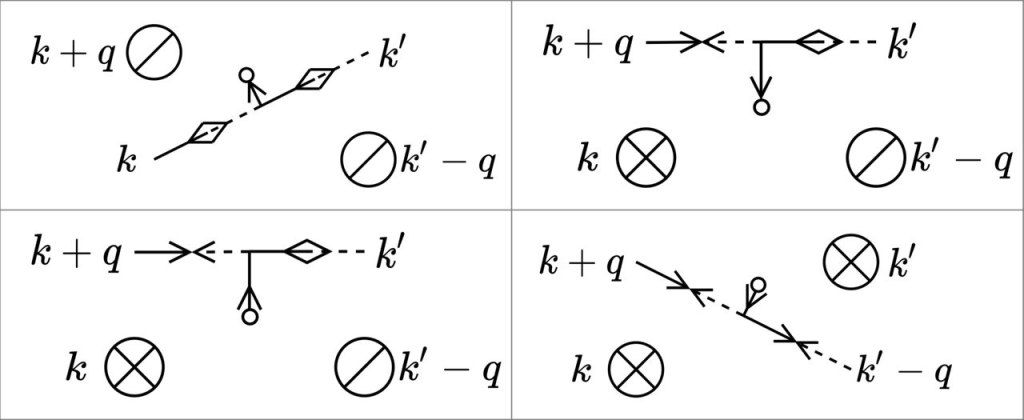
The resulting non-unitary evolution of the reduced density matrix is still a Completely Positive Trace-Preserving (CPTP) Map which is guaranteed by the Stinespring Dilation Theorem: the construction of the non-unitary dynamics is guaranteed to be CPTP if it arises from tensoring a system with a larger bath, evolving the combined system unitarily by a Hamiltonian generator, and subsequently integrating out the bath to obtain an effective evolution for the original system. If the generating operator of the non-unitary evolution (a Liouvillian or Lindbladian) is known in advance, it is possible to directly construct the Influence Functional without resorting to dilation by Trotterizing the evolution. This approach is commonly employed in more recent works.
Non-equilibrium field theory finds applications in a broad range of systems. In our research group, it is predominantly used for the investigation of Microcavity Exciton Polaritons, which are quasi-2D ‘fluids of light.’ Keldysh Field Theory, a specific variant of field theory, is particularly suitable for this purpose. Through a judicious choice of basis for the fields, it facilitates straightforward calculations of the system’s response functions and Green’s functions and allows us to calculate conserved quantities at the level of correlation functions. For instance, one can analyze the flows resulting from an external perturbation (the current-current response tensor) to determine if the system exhibits superfluid behaviour.
R.P Feynman, F.L Vernon – The theory of a general quantum system interacting with a linear dissipative system, Annals of Physics, Volume 24, 1963
Return back to Quantum Fluids of Light.
 qlm-ucl.org